
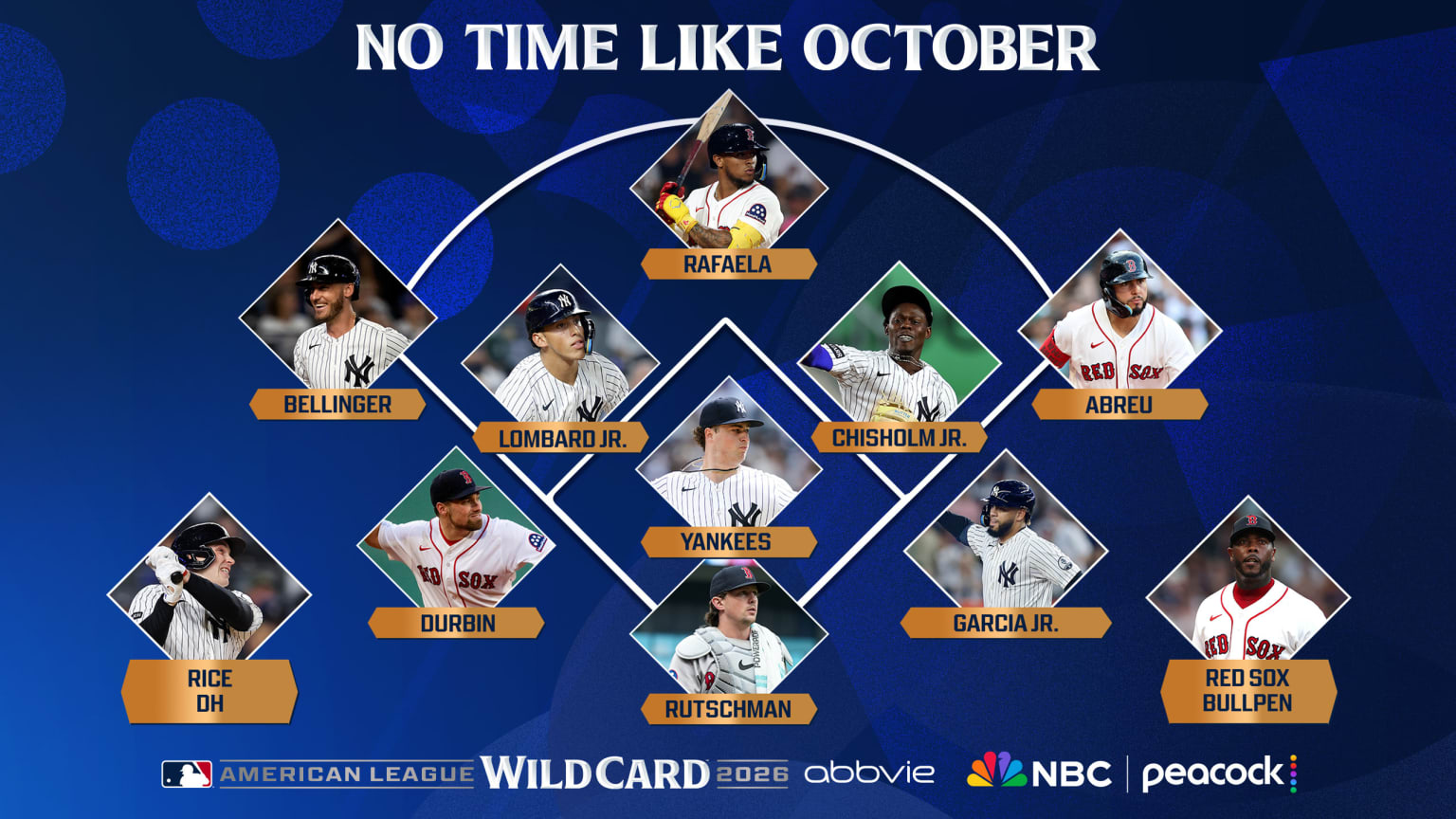
Yankees and Red Sox meet again in October and, as is often the case when these two franchises cross, the names and the story quickly take a backseat. The Wild Card series will be the best of three games and will be played completely at Yankee Stadium, so any small advantage can end up defining who continues in the postseason.
New York arrives with a deep rotation, several young people who consolidated during the season and an offensive that they learned to produce during long absences from Aaron Judge. Boston, meanwhile, got through a very complicated start and ended up finding enough stability to return to October.
When comparing both rosters position by position, interesting differences appear. The Yankees seem to have greater depth in various areas of the frame and in the pitching opener, while Boston presents important arguments behind the plate, in some positions of the gardens and in the last innings.
Receiver: Austin Wells vs. Adley Rutschman
Austin Wells will come to the series with a major responsibility to handle one of New York's strongest pitching corps. Although his offensive production did not reach the levels of his best seasons, he continues to add value as a receiver for his ability to receive pitches, block and work with the pitchers.
Boston introduces Adley Rutschman, who arrived during the season from Baltimore. His offensive production has not been the same as his best years either, but he retains a combination of experience, discipline on the plate and defensive ability that makes him an important piece for the Red Sox.
In a short series, the handling of the launchers can end up being as important as the production with the bat.
First baseman: Luis García Jr. expanded the options of the Yankees
The acquisition of Luis García Jr. ended up being one of New York's most important decisions during the season. The initialist maintained his production after reaching the Bronx and completed a campaign of 30 home runs.
The Yankees also have Paul Goldschmidt as an alternative to left-handed pitchers, an especially useful tool considering Boston's pitching composition.
The Red Sox have in Willson Contreras a dangerous bat, although his physical condition became a concern after receiving a hit in the hand during the last days of the regular season.
Second Base: Jazz Chisholm Jr. Offers Speed and Impact Capacity
Jazz Chisholm Jr. did not have his most dominant offensive season, but he is still a player capable of changing a game in various ways. He surpassed the 40 stolen bases and his combination of speed, defense and power offers Aaron Boone a hard-to-replace piece.
Boston arrives with less stability in that position after several changes during the year. Nick Sogard and Isiah Kiner-Falefa appear among the main alternatives.
In a short format, the ability of jazz to take an extra base or create pressure on defense can become a particularly important factor.
George Lombard Jr. arrives in October as one of the great Yankees stories
The shortstop is one of the positions that changed the most for New York during the season.
George Lombard Jr. debuted on August 4 and quickly began to gain prominence. The 21-year-old showed speed, discipline on the plate, intelligence running the foundations and the ability to produce at important moments.
Boston will have Trevor Story, a player with much more experience in the Major Leagues, but who lost approximately three months from surgery related to a sports hernia.
For Lombard, the Wild Card will represent a completely different test. However, the performances he left during September proved that the Yankee Stadium stage does not seem to intimidate him.
Third base remains one of the biggest questions in New York
If there is a position where the Yankees still have decisions to make, it is the antechamber.
Ryan McMahon did not produce offensively with the expected consistency and Amed Rosario did not manage to completely take over the position either. New York even started working with Anthony Volpe at third base during the last days of the regular season.
Boston seems to have more stability with Caleb Durbin, who managed to recover after a difficult start and ended up becoming a productive piece both offensively and defensively.
The way Boone handles third base could vary depending on the rival pitcher and the moment of the match.
Cody Bellinger brings left field experience
Cody Bellinger arrives in October as one of the Yankees players with the greatest postseason experience.
His second season in New York included a All-Star pick, consistent offensive production, and high-level defense in the gardens.
Boston has Jarren Duran and also recovered Roman Anthony after a major finger injury. Anthony has a considerable offensive roof, but Bellinger offers a combination of experience and stability that can be especially valuable in a series of just three games.
The center field presents physical doubts in both teams
Trent Grisham suffered a hamstring injury during September, a situation that opened up opportunities for Spencer Jones.
Jones took advantage of the space to show power and athletics and is now part of the alternatives that New York can use during the Wild Card.
Boston also had concerns with Ceddanne Rafaela due to an annoyance in the quadriceps. The studies did not show a serious injury and was able to return before the end of the season.
Rafaela offers a very complete combination of speed, arm and defense, so his presence can become an important advantage for Boston in the center of the field.
Aaron Judge continues to be the great uncertainty factor
The situation of the right field inevitably depends on Aaron Judge.
The captain continues to recover from a calf injury and his availability has been one of the great songs around the Yankees before starting the series.
New York has had to prepare for different scenarios and cannot build its entire plan around the possibility of recovering Judge.
Boston has Wilyer Abreu, who finished one of his best offensive seasons, increased his production against left-handed pitchers and continues to offer a solid defense thanks to his arm.
If Judge can play and do it near his usual level, he completely changes the depth of the lineup. If it is not available or limited, the Yankees will need to reproduce collectively as they did for much of the season.
Ben Rice became a centerpiece of the offensive
One of the biggest changes in the Yankees during 2026 was the consolidation of Ben Rice.
Rice surpassed 40 home runs, received his first-ever-star pick and showed that he can produce against right and left-handed pitchers.
With Judge absent for much of the season, Rice went from being an interesting piece to becoming one of the most important hitters in the lineup.
Boston had less stability as a designated hitter after losing Masataka Yoshida for the past few weeks due to a hamstring injury.
Rotation may be the greatest strength of the Yankees
New York arrives at the Wild Card with a collection of openers that allows you to handle the series in different ways.
Cam Schlittler will open Game 1 after finishing a historic season with a 1.95 ERA. Max Fried will receive the ball in the second match and Gerrit Cole is ready for a possible Game 3.
In addition, Carlos Rodón can offer depth from the bullpen during this round.
Boston also doesn't have any options. Payton Tolle had an excellent rookie season, while Sonny Gray and Ranger Suárez bring experience and ability to work important matches.
The difference for New York is in the possibility of starting each meeting with a first-level arm and still maintaining quality alternatives to cover multiple tickets if something does not go according to plan.
The bullpen can decide such a short series
Both teams arrive with groups of relievers who were among the most effective in the Major Leagues.
David Bednar became the main man to close the Yankees matches. Paul Blackburn found a new role as a trainer and Brent Headrick also became a piece capable of generating important strikeouts.
Boston, however, has the depth to cover the last innings. Garrett Whitlock, Greg Weissert and Jovani Morán are part of that group, while Aroldis Chapman continues to be a threat from the ninth episode even at the age of 38.
In a series where the leaders do not need to reserve arms for a full week, it will be normal to see important relievers entering earlier than usual.
A much more even series than the regular season may indicate
The Yankees arrive with local advantage, a deep rotation and an offensive that found different ways to produce even without Judge.
Boston features a dangerous bullpen, an athletic defense, and enough hitters capable of punishing any error in New York pitching.
That is why it is difficult to reduce this series simply to what happened during the previous 162 games.
In three meetings there is no time to correct a bad night. A defensive error, a baseball, a bullpen decision or a single home run can completely transform the fate of either team.
The Yankees have arguments to feel prepared. But in front of Boston, and especially in October, the story shows that absolutely nothing can be taken for granted.