
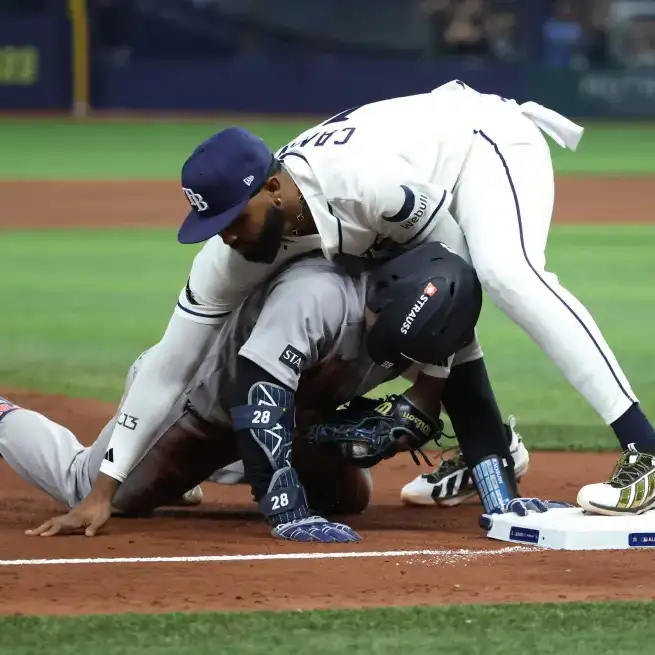
The Yankees' 1-0 loss to the Tampa Bay Rays in ALDS Game 1 left much more than a bad decision by Austin Wells running the bases.
He also left a question that New York needs to quickly answer if he wants to advance in this divisional series:
What really is the identity of these Yankees?
Wells' mistake trying to get to third base after breaking Drew Rasmussen's no-hitter became the most discussed play of the match. But reducing all the defeat to that moment would be to ignore something deeper.
The Yankees need to understand what kind of team they are, what their strengths are and how they should use them against a rival like Tampa Bay.
Austin Wells' error exposed a bigger problem
Wells got the only New York hit in the whole match.
With two outs in the eighth inning and the Yankees losing 1-0, the receiver doubled down the right field line that ended with Rasmussen's no-hit attempt.
The tie race was then in scoring position.
But Wells decided to continue to third.
Tampa Bay's defense perfectly executed the relay and the catcher ended up being eliminated.
The entrance ended immediately.
The play was a mistake, something that both Aaron Boone and Wells himself recognized after the game.
But the important question is why the Yankees came to a situation where they felt they needed to force such a move.
Yankees don't need to become the rays
Tampa Bay is a team built around execution, defense, speed, pressure and exploitation of small errors.
The Rays can win a match with a race.
They can use a perfect defensive relay.
They can turn a rival reading error into a huge advantage.
That was exactly what happened in Game 1.
But the Yankees don't necessarily have to try to beat Tampa Bay playing exactly like Tampa Bay.
New York has other strengths.
has power.
It has offensive depth.
It has batters capable of producing extra bases.
It has a rotation that can keep matches closed.
And he has a bullpen that he has answered during this postseason.
The key is to take advantage of those strengths without abandoning the fundamentals.
Aggressiveness cannot turn into despair
There is a difference between being aggressive and playing desperate.
The Yankees want runners capable of taking an additional base.
They want speed.
They want pressure.
But every decision must have context.
With two outs and losing 1-0, Wells was already in second base.
A single could tie the game.
Getting to Third offered a small advantage.
Being eliminated ended the entry.
That balance between risk and reward is precisely what New York has to improve.
Tampa Bay won playing exactly his style
The Rays didn't need a big offensive night.
Jonathan Aranda hit a solo homer in front of Gerrit Cole and that race ended up being enough.
Then Drew Rasmussen did the rest.
The right-hander pitched eight blank innings, allowed only one hit, gave two walks and struck out 10 batters.
When Wells finally managed to break the No-Hitter, Tampa Bay responded with a perfect defensive play.
Victor Mesa Jr. quickly recovered the ball, Taylor Walls completed the relay and Junior Caminero ended up waiting for Wells in third.
That is playing within a clear identity.
Yankees need to simplify the game
One of the most important lessons in Game 1 is that New York doesn't need to try to do too much.
When a team begins to feel frustrated offensively, there is a temptation to want to solve everything with a single move.
- a home run
- an extra base.
- An impossible hit.
- An aggressive race.
But in October often the best decision is the simplest.
- reach second.
- stay there.
- Give the next batter a chance.
- work a ticket.
- move the corridor.
- Force the rival to get the 27 outs.
The main problem is still the offensive
Wells's mistake was expensive, but the Yankees can't hide behind that move.
New York ended with a single hit throughout the match, the least amount achieved by the franchise in a postseason match.
Drew Rasmussen withdrew 15 consecutive hitters before Wells's double and never allowed the lineup to find pace.
Gerrit Cole allowed only one run in five innings.
The bullpen kept the score 1-0.
That means pitching did enough to compete.
The offensive did not respond.
The contrast with Boston was huge
The Yankees had arrived at ALDS after a completely different Wild Card series.
Against Boston they scored 18 runs in two games.
The alignment produced.
The runners moved.
There was pressure.
There were hits with men in scoring position.
In front of Rasmussen, all that disappeared.
The challenge now is to prevent a bad night from becoming a trend.
Playing your strengths doesn't mean just depending on the home run
Understanding the identity of the Yankees does not mean simply waiting for a home run.
New York can be a team of power and at the same time execute the fundamentals correctly.
can work counts.
You can get bases by balls.
You can move runners.
You can run smart.
can play good defense.
You can use its power when the correct launch appears.
That's different than trying to play as Tampa Bay.
Boone needs his team to make better decisions
Aaron Boone spoke throughout the season about his Yankees' ability to win in different ways.
Now that idea will be put to the test.
The leader needs an aggressive, but disciplined team.
You need players to understand the situations.
He needs each runner to know the score, the outs and the defensive arm in front of him.
In October, a bad read can cost a game.
Game 1 was the perfect example.
The Yankists: The Yankees must know who they are
from the perspective of The Yankists, the problem is not that the Yankees try to create pressure.
The problem appears when they start to move away from what they do best.
New York has enough batters to produce races without having to force every situation.
He has enough pitching to stay within the matches.
He has enough talent to compete with Tampa Bay.
But that talent needs execution.
Do not give out.
Don't run for running.
Do not chase pitches outside the area.
Don't get desperate because the game is 1-0.
That is also part of having an identity.
Game 2 will be a maturity test
Now comes the answer.
Cam Schlittler will have the responsibility to open the second meeting and New York needs to offer you much more offensive support than Gerrit Cole received.
The goal should not be to play a perfect match.
It must be playing a smart match.
If the Yankees return to the Bronx with the series tied 1-1, the panorama changes completely.
But to get it they will have to show that they learned something from Game 1.
The defeat against Rasmussen cannot only become a story about Austin Wells.
It must become a warning for the entire team.
Identity is also demonstrated after losing
A team finds out who he is not only when he is winning.
also when you get a hit.
The Yankees were dominated.
They made a major mistake.
They lost a match that their pitching kept within reach throughout the night.
Now it's time to answer.
And the best way to do it is not to try to become Tampa Bay.
It's playing like the Yankees, but doing better.
with discipline.
with intelligence.
patiently.
And understanding that in October each out has enormous value.