
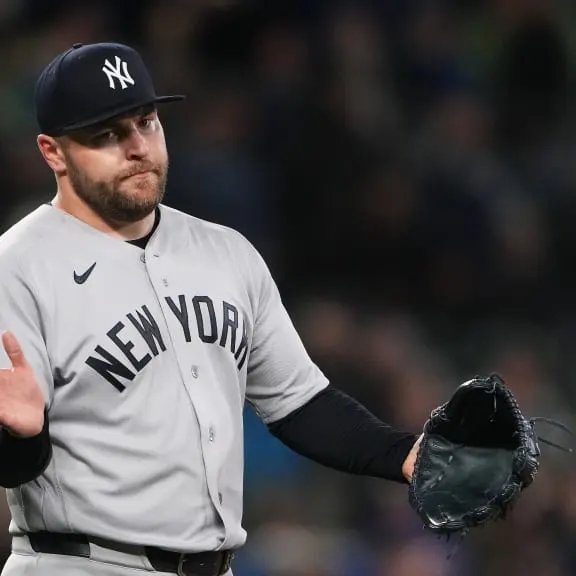
The Yankees have several important decisions to make this winter, but few directly affect the bullpen structure as much as David Bednar's future.
The 32-year right goes to free agency after he consolidated himself as the closer of New York and became one of the most reliable pieces of a body of relievers that ended up being a strength of the team.
The question for Brian Cashman and the main office is no longer whether Bednar can close important matches.
That already proved it.
The real question is how much Yankees are willing to pay to prevent another team from taking one of their most important relievers.
David Bednar became the anchor of the bullpen
Since the Yankees acquired Bednar from the Pittsburgh Pirates on the 2025 trade deadline, the law has offered the stability that New York was looking for for the final tickets.
During his time with the Yankees, he registers a 2.39 effectiveness and has achieved 45 saves.
In 2026 he finished with a 2.47 ERA in 69 innings and a third, the most of his career, in addition to turning 35 of his 39 rescue opportunities.
But its value was beyond simply launching the ninth inning.
Bednar showed willingness to work more than three outs when the team needed it, something that allowed Aaron Boone to use it in critical situations without strictly limiting himself to the traditional closer role.
That flexibility was especially important for a bullpen that had to constantly adapt during the season.
The Yankees bullpen ended up being one of its greatest strengths
Before the season began, questions existed around the New York relay.
However, the group finished with a collective ERA of 3.13, the second best of all the big leagues.
Bednar was a centerpiece within that performance.
His presence also helped establish an identity within the bullpen.
The coaching staff valued throughout the season their willingness to receive the ball in complicated situations and their ability to stay available.
Players like Fernando Cruz, Brent Headrick, Paul Blackburn and other relievers ended up forming a much more effective group than many expected.
And when October arrived, the bullpen continued to respond.
During the postseason, the Yankees relievers only allowed one clean run in 15 innings and two-thirds for a 0.57 ERA.
In an elimination where there were offensive and defensive problems, the bullpen was one of the areas that did carry out his work.
Bednar also had to make adjustments during 2026
Bednar season did not start perfectly.
After participating in the World Baseball Classic, his speed was below usual during the first part of the calendar.
His straight line ended by averaging 96.1 miles per hour, approximately one mile less than during 2025.
Instead of relying solely on speed, Bednar made an important adjustment to his repertoire.
He started using his splitter much more frequently.
The launch ended up becoming one of his most important weapons and allowed him to continue removing batters even when his straight line did not have exactly the same explosiveness.
That ability to adapt also increases its value by entering free agency.
The price can become the big problem
Bednar earned $9 million during his last year of arbitration.
Now you will have the opportunity to freely negotiate with all the teams.
The market will not have a large number of established closers available, something that could greatly increase its price.
There is a possibility that Bednar receives multi-year offers with an average salary of close to 15 million dollars per season.
The Yankees could also consider extending a qualified offer, the projected value of which exceeds 23 million dollars for one season.
That puts New York in the face of an important financial decision.
Is Bednar a significant investment for several years?
Or should the Yankees use that money on other roster needs and try to build the bullpen again with cheaper alternatives?
The Yankees do not have an obvious replacement for the ninth inning
Letting Bednar go would be much easier if the organization had another closer ready to take responsibility immediately.
Right now that answer is not completely clear.
Paul Blackburn will also come to free agency.
Fernando Cruz has had physical problems.
And although Carlos Lagrange has an arm of enormous potential, making him definitely a reliever would be an important decision for his development.
The Yankees could look for a closer in the market, but that also doesn't guarantee that they will find a cheaper or more reliable alternative.
When a team already has a pitcher who has proven to be able to handle the ninth inning pressure in New York, letting it go always includes some risk.
The history of large contracts for relievers generates caution
The Yankees also know the danger of investing too much money in relievers.
Important contracts previously handed over to pitchers like Aroldis Chapman and Zack Britton had irregular results and ended up remembering that the bullpens can be difficult to project in the long term.
Relievers work with extreme physical loads.
A small drop in speed can completely change its effectiveness.
And multi-year contracts can quickly turn into trouble when injuries appear.
In the case of Bednar there is also an element that they must monitor.
The right-hander used his splitter on more than 40 percent of his releases during 2026.
So far it has shown significant durability and has not gone through the list of injured since it reached the Yankees, but any multi-year investment should also consider the physical risk associated with a highly utilized reliever.
The Yankees: Bednar should be a priority, but there is a limit
from the perspective of The Yankists, David Bednar should be among New York's top priorities this winter.
Not because it's impossible to build a good bullpen without him.
The Yankees demonstrated during 2026 that they can develop and find productive relievers.
But Bednar offers something that cannot always be easily found.
It is already tested in New York.
can close.
You can get more than three outs.
He has experience in high pressure situations.
And he became one of the bullpen leaders.
That has value.
However, it does not mean that the Yankees should give you any contract you request.
If the market takes its price to figures that are too high or too many years guaranteed, Brian Cashman will have to evaluate alternatives.
The objective should be to maintain the strength of the bullpen without unnecessarily compromising resources that will also be necessary to improve other areas of the roster.
One of the first big decisions of winter
The Yankees will have several free agents and numerous positions to evaluate before starting the 2027 season.
But Bednar's situation could be resolved relatively early because the closer market does not seem particularly deep.
That can generate competition.
Bednar comes from a solid season, has experience as a closer and is still at an age when several teams may consider reasonable to offer you a multi-year contract.
New York knows exactly what he has with him.
The question is how much it costs to keep it.
After a season in which the bullpen ended up being one of the team's greatest strengths, the Yankees will have to decide if David Bednar will continue to be the man in charge of getting the last three outs in 2027.