
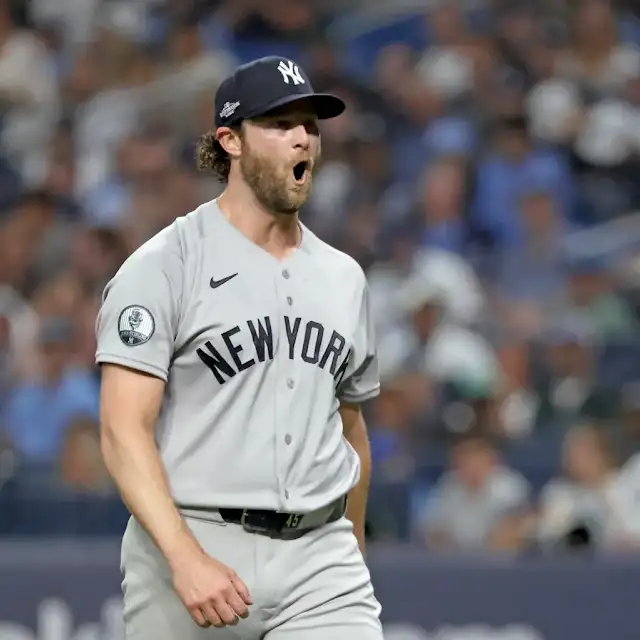
The Yankees get to the offseason with a problem that many organizations would like to have: more pitching options available than positions available in a traditional rotation.
Cam Schlittler.
Gerrit Cole.
Max Fried.
Carlos Rodon.
Ryan Weathers.
Will Warren.
Clarke Schmidt.
In addition, the organization has young people like Carlos Lagrange and Elmer Rodríguez who continue to get closer to the Major Leagues.
At first glance, that depth could turn some of those launchers into a logical piece to make an exchange and solve other needs of the roster.
But New York has important reasons to act carefully.
The depth that today seems excessive can disappear very quickly when injuries, ticket limitations and the needs of a season of 162 games begin.
Yankees has an advantage that shouldn't waste
Unlike many teams that will start the winter desperately looking for starters, the Yankees do not need to enter the market thinking that they must buy a full rotation.
That represents a huge advantage.
New York can concentrate resources in other areas.
the third base.
the gardens.
the bullpen.
offensive depth.
But having several openers available can also cause the temptation to use one of them as a bargaining chip.
That wouldn't necessarily be a mistake.
It all depends on the player who returns in the negotiation.
The problem would be to assume that the Yankees have so many pitchers that they can easily detach from several without affecting their depth.
2026 injuries serve as a warning
Last season it left a fairly clear lesson.
Gerrit Cole, Max Fried, Carlos Rodón, Clarke Schmidt and Ryan Weathers lost time due to different physical problems.
Schmidt could not even launch during the season while continuing to recover from Tommy John surgery.
That means that five of the main arms currently appearing in the plans for 2027 come from marked seasons, to a greater or lesser extent, for health reasons.
And that reality completely changes the way depth should be assessed.
A team can start February thinking that it has seven starters.
By May you may be desperately looking for a fifth pitcher.
Cole, Fried and Rodón also require planning
The age of some of the main launchers is another factor that New York cannot ignore.
Cole will launch at 36 years old.
Fried will be 33.
Rodon will be 34.
All three are still pitchers capable of mastering when they are healthy, but the organization needs to carefully manage its loads.
It would not be wise to build a season assuming that each will make 30 openings automatically.
That's why having Schlittler, Weathers, Warren and other available alternatives becomes even more important.
Cam Schlittler completely changes the structure
The appearance of Cam Schlittler is one of the reasons why the Yankees can feel so comfortable with their rotation.
The law went from being a young option to becoming one of the team's most important pitchers.
Its growth allowed New York to go through different injuries without completely losing the stability of the rotation.
But Schlittler also comes from taking on a considerable workload during the early stages of his career.
That deserves follow-up.
The same goes for Will Warren.
The Yankees need sufficient depth to be able to manage their young people without forcing them to unnecessarily carry all the rotation.
Ryan Weathers also strengthened the depth
Ryan Weathers came out of 2026 with much more value within the organization.
The left-hander ended up showing that he can be part of a competitive rotation when he is healthy.
That makes it an attractive piece.
It could also make him an interesting player for other teams in exchange conversations.
But precisely for that reason New York has to carefully evaluate any proposal.
Weathers offers depth, relative youth and contractual control.
Getting rid of that type of opener only makes sense if the return solves an important need.
Clarke Schmidt can start 2027 in another role
Clarke Schmidt's situation is different.
After losing 2026 while recovering from Tommy John, his exchange value is much more difficult to determine.
The Yankees don't yet know exactly how much load they can take immediately.
One possibility would be to start using it from the bullpen.
That would allow you to return progressively while at the same time helping one of the areas that most need reinforcements.
Schmidt already has experience launching both as a starter and a reliever.
That versatility can be valuable to Aaron Boone.
Will Warren can also offer flexibility
Warren appears in a similar situation from the roster's point of view.
If the five positions in the rotation are occupied at the beginning of the season, New York could keep it ready as depth in Triple-A or consider using it in the bullpen.
But that doesn't mean it's no longer necessary.
A full season almost always forces you to use much more than five starters.
Having a pitcher ready to enter immediately can prevent the organization from having to make a desperate move midway through the calendar.
Luis Gil could be a different situation
Among all the arms available, Luis Gil seems to represent one of the most complicated cases.
The Yankees will have to decide what real role they have within their plans.
He no longer has minor league options, which means that to keep him he would have to stay on the major league roster or be exposed to waivers.
That can lead to New York to seriously explore an exchange before the deadline to offer contracts.
Another possibility would be to try to transform it into a reliever.
His repertoire has always had features that could work on short inputs.
But the organization will have to decide if it still considers that it can recover enough value as a starter.
Carlos Lagrange and Elmer Rodríguez represent the future
The Yankees also have two very interesting young arms in Carlos Lagrange and Elmer Rodríguez.
Both can eventually impact the Major League team.
However, New York will probably prefer to start 2027 by keeping them within starter programs.
Especially Lagrange generates an interesting conversation.
His three-digit speed repertoire could turn him into a dominant reliever.
But using it immediately in the bullpen would mean abandoning, at least temporarily, the possibility of developing it as a starter.
And starters with that kind of arsenal are too valuable to make that transition without carefully analyzing it.
The real problem is in the bullpen
While the rotation offers depth, the bullpen practically presents the opposite scenario.
David Bednar will arrive at the free agency.
Paul Blackburn too.
Tim Hill and Ryan Yarbrough can leave.
Fernando Cruz faces questions related to his health.
And Brent Headrick finished 2026 after a huge load of work.
Headrick led the Major Leagues with 81 appearances.
That means the Yankees need to rebuild a considerable part of the reliever group.
And that's where some of those additional openers can become an internal solution.
David Bednar is once again a priority decision
Bednar will probably be the most important decision of the bullpen.
New York has the possibility of presenting a qualified offer of approximately $23.15 million.
If he accepts it, the Yankees would pay a high salary for one season, but would keep their closer without committing for three or four years.
If you reject it and sign it with another team, New York could receive compensation in the draft.
This may be attractive to an organization that has avoided giving too long contracts to relievers in recent years.
Previous experiences with important agreements for Aroldis Chapman and Zack Britton left reasons to act wisely.
Paul Blackburn can also become an expensive decision
Blackburn was another of the bullpen's positive stories.
Its transformation from opener to reliever ended up working and its value increased considerably.
Now it will come to the free market.
The problem is that good relievers receive major contracts.
A multi-year agreement to retain Blackburn could end up costing much more than New York expected when it initially made it a piece of the bullpen.
That will force Brian Cashman to compare his price with other available alternatives.
Yankees will need another left-handed reliever
The possible departure of Tim Hill and Ryan Yarbrough also leaves an obvious need from the left side.
The market includes interesting options.
Adrian Morejon stands out among them.
Other lefties will also be available that can attract attention from New York.
But some will receive important contracts.
The Yankees will have to decide how much they want to spend on relievers and how much they can solve internally.
Jeremiah Estrada is a name to watch
The exchange market also offers alternatives.
One of the names that the Yankees have previously observed is Jeremiah Estrada, right reliever of the San Diego Padres.
Estrada has material to work in high pressure situations and still has years of contractual control.
That type of pitcher is attractive to a team that needs to rebuild the latest entries.
But again the same question appears.
What would New York have to deliver to get it?
If the price includes one of your best young arms, the negotiation would have to be evaluated with great care.
The depth of openers can help rebuild the bullpen
One of the most interesting solutions can be found within the roster itself.
Schmidt.
Warren.
Gil.
Lagrange.
Rodriguez.
Not everyone needs to permanently become relievers.
But some could temporarily occupy functions within the bullpen depending on how the rotation is configured.
That would allow the Yankees to avoid having to buy eight different relievers during the same winter.
It would also offer arms capable of working multiple inputs.
The Yankistas: You don't have to change pitch simply because there is plenty in October
from the perspective of The Yankists, New York should listen to offers for some of its pitchers.
That is completely logical.
If a team offers a third impact base.
A defensive center fielder.
or a high-level young reliever.
Brian Cashman has to listen.
But listening to offers does not mean having an urgency to let go of the depth.
The mistake would be to look at a seven-name rotation in October and assume that there will be seven healthy options when June arrives.
The recent history of the Yankees proves exactly the opposite.
The lesions appear.
Workloads change.
Some pitchers go back.
Others need breaks.
And at that moment the thrower that seemed left over during the winter can quickly become indispensable.
Pitching is precisely one of the strengths that Yankees must protect
Yankees need to modify important parts of the roster by 2027.
That's clear.
But they also need to correctly identify which areas should not weaken.
Opener pitching is one of them.
Schlittler offers present and future.
Cole, Fried and Rodón bring experience.
Weathers and Warren provide depth.
Schmidt can become a flexible piece.
Lagrange and Rodríguez represent young alternatives.
And Gil can still retain some value.
The Yankees can use part of that depth to improve the equipment.
But any exchange has to make them clearly better.
Having many openers is not a problem.
The problem begins when an organization thinks it has too many, changes them and months later it discovers that it needed exactly the arms it decided to deliver.