
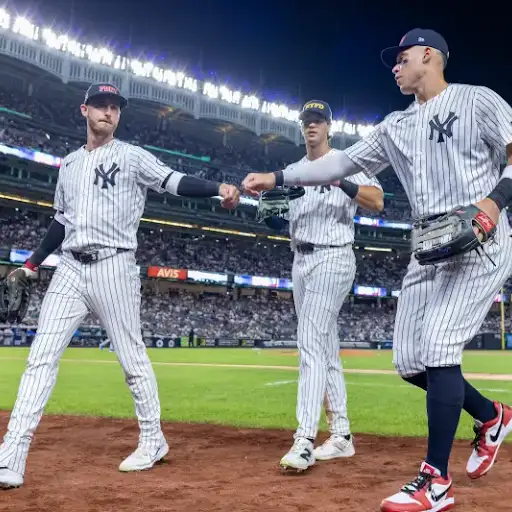
The Yankees enter winter with several important decisions around their roster, but few can modify both the team's construction and the evolution of Spencer Jones.
The young outfielder finally received an important opportunity in the Major Leagues during 2026 and showed many of the tools that for years made him one of the most striking prospects of the organization.
There was power.
There was speed.
There were times when she seemed able to quickly become a permanent piece within the lineup.
But the same questions that accompanied him during his tour of the minor leagues also appeared.
Will you be able to reduce strikeouts?
Can you consistently produce against right pitchers?
Are you ready to defend center field every day?
The answers to those questions may end up determining much of the Yankees' plan for their gardens in 2027.
Spencer Jones left important signs in his first season
Jones played 84 games for the Yankees during the 2026 regular season.
He ended up batting for .245, with a .314 on-base percentage and .435 slugging.
He hit 11 home runs.
He promoted 39 races.
scored 34.
and stole 10 bases.
For a player living his first extensive experience in major leagues, the numbers showed that his tools can be translated to the highest level.
Jones continues to be a batter capable of changing a match with a single swing.
Its size, strength and speed of output produce a level of power that few players can match.
And despite measuring 6 feet and 7 inches, it also provides speed at the bases.
That physical package explains why the Yankees continue to see such a high ceiling.
Punches are still the big concern
But the potential is also accompanied by an obvious risk.
Jones struck out 102 times over 281 plate appearances in the regular season.
That volume of strikeouts is still too high for a player who aspires to occupy an important position every day within the lineup.
The problem did not suddenly appear in the Major Leagues.
During his development in the minors, the swing-and-miss was constantly one of the main issues around his offensive profile.
The Yankees accepted that risk for years because the potential prize was huge.
An oversized left-handed hitter capable of producing elite power, running the foundations well, and defending the gardens has considerable value.
But when it's time to build a team with World Series aspirations, consistency matters as much as tools.
Its production against right pitchers generates an unexpected question
One of the most interesting facts of his season was the difference between his results against left-handed and right-handed pitchers.
Jones, being a left-hander, produced much better against left-handed pitchers.
Against right pitchers he ended up batting .202, with a .288 on-base percentage and .380 slugging.
His OPS was .668.
Facing lefties, although in a considerably smaller sample, produced much higher numbers.
That creates an important question for Aaron Boone and the coaching staff.
Jones cannot become an everyday player if he needs to be constantly protected against the group of pitchers he will face most frequently.
The next step in your development will be to find a way to produce much more consistently against right pitchers.
The second half left reason to believe
Despite the difficulties, Jones also showed progress as the season progressed.
After the All-Star Game ended with an .820 Ops.
In September he batted .304 and recorded a percentage of .448 on-base.
That closure offers an important reason for the Yankees to be patient.
We are not talking about a player who reached the Major Leagues and remained completely stuck.
There were adjustments.
There were better shifts.
And there were signs that he began to better understand how the pitchers were trying to attack him.
That is precisely what the organization needs to continue to develop during 2027.
The center field can become the great question mark
The offensive is not the only part of the evaluation.
The Yankees also have to decide how much they trust Jones defensively.
Its athletics allows you to cover ground and your arm offers possibilities in any of the three positions of the gardens.
But playing center field regularly at Yankee Stadium requires much more than speed.
readings.
routes.
first step.
communication.
and consistency.
The organization will have to determine if Jones is ready to take on that responsibility or if his best long-term position will end up being one of the corner gardens.
That decision can completely change the type of player Brian Cashman looks for during the winter.
Cody Bellinger offers security, but also flexibility
Cody Bellinger continues to be one of the most important pieces of Outfield.
The Yankees signed it for five seasons and $162.5 million before 2026.
Your contract includes options to go out after the 2027 and 2028 seasons.
In addition to his offensive production, Bellinger can defend the three positions of the gardens and also first baseman.
That versatility allows Boone to build different lineups depending on how Jones evolves.
If Jones proves that he can handle center field, Bellinger could mostly stay in a corner.
If the young man needs more time defensively, Bellinger offers an experienced alternative to cover the center.
The problem for long-term planning is that the Yankees can't assume that Bellinger will necessarily be there for the entire duration of his contract.
Your exit option after 2027 forces the organization to think beyond a single season.
Aaron Judge's health also affects the plan
Aaron Judge will continue to be the center of everything the Yankees do.
But the 2026 season again recalled that the organization needs to physically protect the captain.
Judge lost an important part of the calendar due to different injuries.
As your career progresses, the Yankees will have to carefully manage how much time they spend in the gardens and how much they can eventually spend as a designated hitter.
That makes it even more important to develop young gardeners capable of occupying permanent positions.
If Jones becomes one of them, New York gets much more flexibility to handle Judge without defensively weakening the Outfield.
Jasson Domínguez becomes part of the equation again
There is also Jasson Dominguez.
For years it was considered one of the main prospects of the entire organization.
However, his role within the team has changed considerably.
The arrival of Bellinger, the development of Jones and the different needs of the roster have created a much less clear scenario for Domínguez.
The Yankees can still keep it in depth and continue to expect it to reach its potential.
But they can also explore their value in the exchange market.
If there is an opportunity to use Domínguez within an exchange to solve third base, strengthen the bullpen or cover another important need, Brian Cashman will have to consider it.
Jones' existence makes that conversation much more possible.
Jones can save the Yankees millions
There is another reason why Spencer Jones development is so important.
money.
The Yankees already have more than $200 million committed to a small group of players by 2027.
Aaron Judge.
Cody Bellinger.
Gerrit Cole.
Max Fried.
Carlos Rodon.
Giancarlo Stanton.
Ryan McMahon.
When an organization has so many large contracts, it needs productive young players under contract control.
George Lombard Jr. can provide that in the inner box.
Cam Schlittler does it in the rotation.
Ben Rice adds it offensively.
And Spencer Jones can become that piece inside the gardens.
Power continues to be a special tool
Before reaching the Major Leagues, Jones had just shown for years that he could produce power at impressive levels.
In 2025 he hit 35 home runs between Double-A and Triple-A.
He finished that season with OPS over .930.
And during the start of 2026 in Triple-A, he returned to show some of the best start speeds of the minor leagues.
That power did not disappear when he reached the Bronx.
Jones hit 11 home runs in only 253 official turns during his rookie season.
The challenge is to turn more of your contact opportunities into that kind of damage.
Because when you connect the ball, few players within the organization can produce the same impact.
The postseason also showed what is still missing
Jones received important opportunities during October.
In five postseason games he finished 17-3, with a double, an RBI and eight strikeouts.
That perfectly reflects the duality around your profile.
It can help in different ways.
can run.
can produce power.
can create pressure.
But against postseason pitching, where errors are scarce and pitchers constantly attack weaknesses, contact becomes a necessity.
Jones will have to show that he can adjust when the pitchers change his plan against him.
The Yankees shouldn't build without an alternative
Trusting Jones does not mean that the organization should enter 2027 without depth.
That would be an unnecessary risk.
If the Yankees believe that they can become a starting central gardener, they should still add an alternative capable of defending the position.
A player who can enter the games late.
that certain meetings can begin.
and that allows Jones to move to a corner if defensively is necessary.
The season is too long to build an outfield around three players with no real alternatives.
Especially after the injuries that New York suffered during 2026.
The Yankists: Spencer Jones must receive the opportunity
from the perspective of The Yankists, the Yankees have to give Spencer Jones a real chance in 2027.
We are not talking about a player who needs another full season waiting in Triple-A.
He has already shown that he can compete in the big leagues.
Now you need to play.
You need to take turns.
You need to face right pitchers.
You need to make defensive mistakes and learn from them.
And mainly you need to find out if you can become a permanent piece of this equipment.
But giving him a chance doesn't mean giving him a job either.
The Yankees want to win now.
Judge is entering a stage of her career where each season has a lot of value.
Development has to live with the demand to compete.
2027 can define the future of Spencer Jones
Jones has already passed the first test.
He came to the big leagues.
He hit his first home runs.
produced major races.
He played in October.
And he showed that his tools belong to this level.
Now comes a much more complicated test.
show that it can be consistent.
reduce strikeouts.
Improve against right pitchers.
defend an important position.
and become someone around whom the Yankees can design their Outfield for several years.
If Jones takes that step, Brian Cashman will have an internal response for one of the most difficult positions to cover.
If you don't get it, the Yankees could be forced to return to the market looking for another solution.
That is why the New York Gardens plan for 2027 begins, to a great extent, with a single question:
How good can Spencer Jones be?