
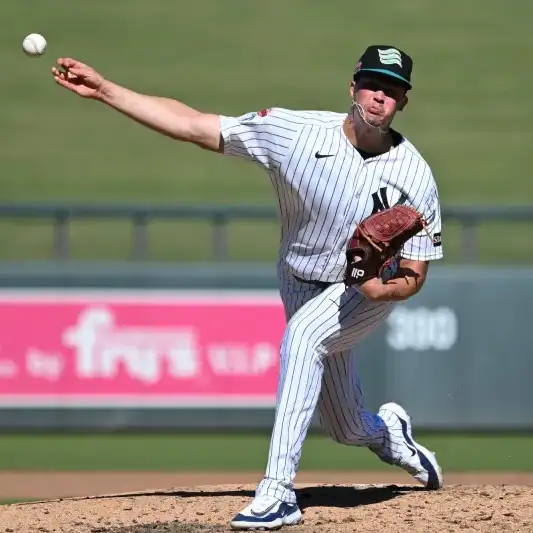
In a low season where much of the conversation around the Yankees has focused on what needs to change, there is another story that deserves attention: New York continues to find arms out of traditional paths and trying to turn them into pieces with real value within the organization.
J.T. Etheridge is one of the most interesting examples.
He was not selected in the draft.
It did not arrive accompanied by a huge bonus.
It does not yet appear among the big names that dominate the prospectus lists.
But the 24-year right has begun to generate interest thanks to a difficult combination to ignore: size, ability to strike out, a repertoire still under development and a second half of 2026 that completely changed the direction of its season.
For the Yankees, Etheridge represents exactly the type of bet that can end up producing value without having to invest a high draft selection or millions of dollars.
From being out of the draft to sign with Yankees
Etheridge's path to professional baseball was far from conventional.
The right pitcher finished his college career in Louisiana-Lafayette with no guarantees on what his next step would be.
He had interesting tools, especially a straight line with life and ability to generate strikeouts, but he had also shown inconsistency and control problems.
During his last year college he struck out 52 batters in 32 innings and two-thirds.
However, the 20 rounds of the 2024 draft ended without any team pronouncing their name.
For many players, that moment represents practically the end of the professional path.
The Yankees saw something else.
New York had maintained communication with Etheridge and finally decided to offer him an opportunity as an unselected free agent.
He signed for a US$70,000 bond.
It was not a spectacular investment from an economic point of view.
But precisely there begins the interesting thing about this story.
Yankees opted for tools, not on the resume
Etheridge measures 6 feet and 6 inches and has a physical structure that immediately attracts attention on the mound.
Your straight can work around 93-95 miles per hour and has reached 97.
He also uses a sweeper at the 80-mile lows.
The challenge has always been to turn those tools into a consistent enough repertoire to face professional batters.
And that's where the development work comes in.
The Yankees did not sign Etheridge expecting to immediately receive a finished product.
They signed it because they understood that there were characteristics that could work.
size.
extension.
Ability to generate failed swings.
an unconventional launch angle.
and an arm living enough to justify patience.
An injury quickly stopped his first attempt
The development also did not start in a simple way.
After entering the Yankees system, Etheridge lost much of 2025 due to a back injury.
The interruption was important for a pitcher who needed to precisely accumulate innings and gain experience.
That made 2026 practically his first real chance to show what he could do for a full season.
The initial results were irregular.
There were strikeouts.
many.
But bases by balls, constant traffic and entrances also appeared where it was difficult for him to completely control his repertoire.
The talent was visible.
Consistency not yet.
General numbers don't tell the whole story
Etheridge finished the 2026 regular season with the Tampa Tarpons scoring 10-3, 5.17 ERA and 1.46 Whip.
At first glance, an effectiveness greater than five does not seem like the statistics of a prospect who should generate too much enthusiasm.
But there are other numbers that considerably modify the evaluation.
In 71 innings and a third, Etheridge struck out 105 batters.
His average of 13.3 strikeouts for every nine innings was the best among all the Yankees minor league pitchers who worked at least 60 innings during 2026.
That represents an important signal.
It doesn't mean he's ready for big leagues.
It also doesn't eliminate command problems.
But it shows that its releases have real capacity to dominate batters.
The season finale showed a different version
The most interesting part began when Etheridge began to trust what he does best.
For much of the year he had gone through trouble consistently attacking the area.
In the final stretch he began to use his straight line with greater conviction and to work with a more aggressive mentality.
The results changed.
According to highlights during his development, he closed his first full campaign with 22 consecutive entries without allowing races, including the postseason, and accumulated 30 strikeouts during that period.
Suddenly, the same pitcher who had gone through extremely difficult times began to show why the Yankees had decided to bet on him two years earlier.
That stretch doesn't automatically make Etheridge a future star.
But it does change the question.
It's not just about knowing if he has enough talent anymore.
Now it's about determining how far you can go if you manage to control that talent.
The Arizona Fall League represents the following exam
The Yankees sent Etheridge to continue their development with the Salt River Rafters in the Arizona Fall League.
The decision makes sense.
At 24 years old, he needs to face more advanced hitters and accelerate some stages of his development.
During his first appearances in Arizona, he once again demonstrated his ability to generate failed swings.
In his first three starts he struck out 13 batters in nine innings and kept the rivals on average at .206.
In addition, he managed to strike out in each of those first three presentations to a prospect located within the MLB Pipeline Top 100.
Subsequently, difficulties also appeared, particularly with the bases by balls.
That confirms that Etheridge continues to be a project under development and not a finished product.
The third launch can determine your future
One of the aspects that the Yankees are working on is the need to offer you a reliable third option.
Etheridge has mainly depended on his straight line and his sweeper.
That can work at low levels.
But as a launcher progresses within the system, batters have a greater ability to recognize patterns and expect certain pitches.
During the Arizona Fall League, he began working with a variant of Splitter as an alternative to a change that had previously been inconsistent.
The idea is simple.
He needs a pitch that hitters, both right and left-handed, have to respect in addition to the straight and the breaker.
If he manages to develop that third weapon, his roof can increase considerably.
The command is still the big question
If there is an aspect that will determine how far Etheridge can go, it is its ability to consistently launch strikes.
The strikeouts draw attention.
The straight line has interesting features.
Size helps create uncomfortable angles.
But none of those elements can permanently compensate for excess bases by balls.
Higher level batters punish any command issues much more frequently.
That is why the next step does not necessarily consist of looking for more speed.
It consists of making better use of what you already have.
attack early.
Reach two strikes first.
Force the batter to defend the area.
And use your side shots from a position of advantage.
Etheridge shows another part of Yankees' work
During the last few months the Yankees have received criticism for different reasons.
Roster construction.
fundamental errors.
offensive decisions.
Results in October.
Culture.
internal responsibility.
Many of those conversations are legitimate.
But correctly evaluating an organization also requires recognizing areas where positive results exist.
Pitching development continues to be one of them.
And Etheridge represents precisely the type of player who helps prove it.
Not all important arms arrive as great prospects
The value of a development system is not just about turning a first-round pick into a major league player.
That's important.
But there is another part of the work that often goes unnoticed.
Find talent where other teams did not find him.
Sign an unselected free agent.
detect a special feature.
modify a repertoire.
Help a pitcher understand how to best use his releases.
And eventually convert a small investment in depth for the organization.
The Yankees have gained value from that process with different arms over the past few years.
Etheridge tries to become another.
Your future is still far from defined
It is also important to keep expectations under control.
Etheridge is 24 years old and has not yet thrown above Class A.
Your command still needs work.
The overall effectiveness of its first full season shows that there are still important aspects to correct.
And a good streak of several openings does not guarantee that a pitcher will arrive at Yankee Stadium.
The next step should take you to a more demanding level within the system.
There we will begin to know much more.
If the strikeouts continue to appear.
If the bases are reduced by balls.
If the third launch is consolidated.
and if you can keep your repertoire for five or six more advanced hitters.
The Yankists: Here is one of the strengths that Yankees must protect
from the perspective of The Yankists, this story deserves attention precisely because we are not talking about a star yet.
We are talking about the process.
The Yankees found a pitcher that no team selected in 20 rounds of the draft.
They signed it for $70,000.
They had patience after an injury.
They worked with their tools.
And two years later they have an arm that led their minor league system in pitching between pitchers with a significant load of innings.
That has value.
Etheridge may end up being a starter.
Maybe his repertoire finally fits better in the bullpen.
It can become a piece for an exchange.
Or he may never get to settle in big leagues.
Prospect development works like this.
The important thing is that a minimal investment has already become a player enough interesting to continue watching it.
2027 may be the year that defines your true place in the system
The next season will be especially important for Etheridge.
He has already shown that he can strike out class A batters.
He has already gone through a first complete campaign.
You have already experienced a period of dominance.
And he is already facing superior talent in Arizona.
Now you have to show that you can repeat it at higher levels.
The talent is there.
The ability to generate failed swings as well.
The big question will still be the command.
If he manages to take that step, J.T. Etheridge can start to climb quickly within an organization where launcher development continues to produce interesting stories.
While the Yankees work this winter to correct what went wrong in 2026, they also need to protect and continue to strengthen what they are doing well.
Finding and developing arms like Etheridge belongs to that second category.