
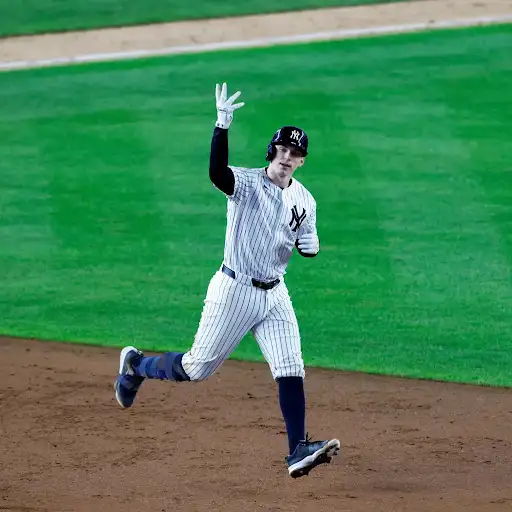
For years, one of the most repeated narratives around the New York Yankees was simple: when the team needed a star, the solution came from outside.
X · Abrir publicación original ↗
Large contracts, free agents, important exchanges and established names have been part of the identity of an organization accustomed to competing with one of the highest payrolls in the Major Leagues.
But the 2026 season has shown another face.
The Yankees still have stars and players acquired through significant investments, but a considerable part of their success was born this time within the organization itself. Ben Rice, Cam Schlittler, George Lombard Jr., Spencer Jones and other players developed in the system ceased to be simply names for the future and began deciding important matches in the present.
A season that forced the Yankees to look inward
The change did not happen only by planning. It also appeared out of necessity.
Injuries hit New York during different stages of the season. Aaron Judge lost a considerable part of the schedule, Gerrit Cole was returning from Tommy John surgery, and other veterans also went through periods out of action.
That scenario forced the Yankees to ask for answers to younger players than they could initially be planned.
And several of them responded.
Instead of expecting all solutions to come from the market, New York began to find production within its own development system.
Ben Rice went from promise to center piece
One of the best examples is Ben Rice.
The left-handed hitter ceased to be simply an interesting alternative to becoming one of the most important pieces of the offense.
Rice finished the regular season with 41 home runs and came to October as one of the hitters New York needed to make up for Judge's absence.
Its impact became even clearer in Game 1 of the Wild Card against Boston.
Rice hit two home runs, including a Grand Slam, and produced six runs in the Yankees' 9-0 win.
It was not an isolated performance. It was the continuation of a season in which he showed that he can occupy an important place within the offensive core of New York.
Cam Schlittler changed the conversation about the rotation
If Rice represents the offensive transformation, Cam Schlittler did something similar from the mound.
The right-hander finished the regular season with a 1.95 ERA and became one of the most dominant American league pitchers.
What is significant is that New York did not start the season thinking that Schlittler would end up occupying such a place within a rotation that also includes names like Gerrit Cole, Max Fried and Carlos Rodón.
Performance ended up changing the hierarchy.
When the postseason began, Aaron Boone did not hesitate to give him the ball to open the first game against Boston.
Schlittler replied again: he pitched 6⅓ innings without allowing runs and struck out 10 batters.
It is no longer about evaluating what could become in the future. The law is already launching important matches in October.
George Lombard Jr. accelerated his arrival to the present
Something similar happened with George Lombard Jr.
The young shortstop reached the Major Leagues during the second half of the season and had to quickly go through the normal adaptation process.
There were defensive mistakes, offensive adjustments, and tricky moments, but the Yankees decided to allow him to continue learning at the highest level.
The answer ended up being important.
Lombard improved during the final stretch and came to October occupying the shortstop of a team with championship aspirations.
In the Wild Card series against Boston, he finished with four hits in eight turns, produced one run, and scored three times. His postseason debut included three unstoppables and several historical brands related to his age. :chatgpt-content-reference{index="1"}
Spencer Jones brings something that these Yankees needed
The value of Spencer Jones cannot be measured solely by home runs or driven runs.
Its speed and athletics offer the Yankees an element that for some seasons was not present often enough.
During the second match against Boston, a perfect example appeared.
Jones struck out, but the ball escaped from the catcher. He ran to the first one, later stole second and advanced another base taking advantage of a bad shot. Shortly after, Lombard took him to the plate.
The sequence helped start the rally that ended up breaking the game.
None of those actions appeared as a home run in the Box Score, but they represent the kind of pressure that a postseason match can change.
The Yankees no longer depend only on power
The evolution of young people also coincides with a broader change within the style of the team.
New York still has power. That feature will never go away as long as you play at Yankee Stadium and have batters capable of changing a match with a single connection.
But the Wild Card against Boston showed another version.
The Yankees stole bases, used speed, placed the ball in play, worked counts and produced with runners in scoring position.
In the two games against the Red Sox they ended up batting 9 of 20 with runners in scoring position and also generated several runs through pressure on the defense. :chatgpt-content-reference{index="2"}
That offers a less predictable offensive.
The great investment is still there, but now there is greater balance
All this does not mean that the Yankees have abandoned their traditional way of building a roster.
Gerrit Cole continues to be a fundamental piece. Max Fried came through a significant investment. Cody Bellinger continues to occupy a central place within the lineup.
The difference is in what exists around them.
Established players no longer have to produce absolutely everything.
Rice can decide a match.
Schlittler can dominate a series from the mound.
Lombard can occupy the shortstop.
Jones can change an entry with his legs.
Austin Wells is also a product of the system and continues to be the main receiver of the equipment.
That combination between external investments and internal development offers a much more balanced construction.
Player development had been a constant criticism
During different stages of recent years, one of the main criticisms of the organization was precisely related to the difficulty in turning prospects into impact players.
Not all projects worked. Some young people did not meet expectations and others needed more time than expected.
But the current generation is beginning to deliver important results.
An analysis published during September already pointed out that the Yankees were forming a young core developed internally around Schlittler, Rice, Wells, Jones and Lombard. The postseason has begun to reinforce that idea. :chatgpt-content-reference{index="3"}
The transformation came while the season was underway
Perhaps the most interesting thing is that these Yankees did not start the year exactly with this identity.
The team changed as the season progressed.
Injuries opened up opportunities.
Some prospects arrived earlier than expected.
Other players assumed major responsibilities.
Boone had to modify positions, defensive combinations and functions within the pitching corps.
What ended up appearing was a younger, more athletic team with more alternatives than the one that started the calendar.
Even rival evaluators have highlighted that this version of New York is more athletic than several recent Yankees teams, particularly because of the presence of Jones and Lombard. :chatgpt-content-reference{index="4"}
October will determine how much history has really changed
Two wins against Boston are not enough to declare the process finished.
Tampa Bay now arrives, the team that won 98 games, conquered East of the American League and ended up ahead of New York during the regular season.
The divisional series will offer much more extensive testing.
The Rays will force the Yankees to defend better, run the bases well, control the strike zone, and take advantage of opportunities that will probably be much more scarce.
That will be where this new identity has to prove if it can be sustained.
These Yankees found answers where there were questions before
The 2026 season is not over yet, so any definitive evaluation will have to wait.
But something already seems different.
The Yankees still have stars. They keep spending. They keep looking for established players when they consider that they can improve the roster.
What has changed is that now they also have young people capable of sharing responsibility.
Rice and Schlittler are no longer simply developmental stories.
Lombard and Jones are starting to walk that same path.
And as New York prepares to take on Tampa Bay in the ALDS, that transformation may end up being one of the factors that define how far the team will go in October.
The old narrative said that the Yankees needed to buy all their answers.
The 2026 Yankees are proving that some of the most important ones can also grow inside the house.