
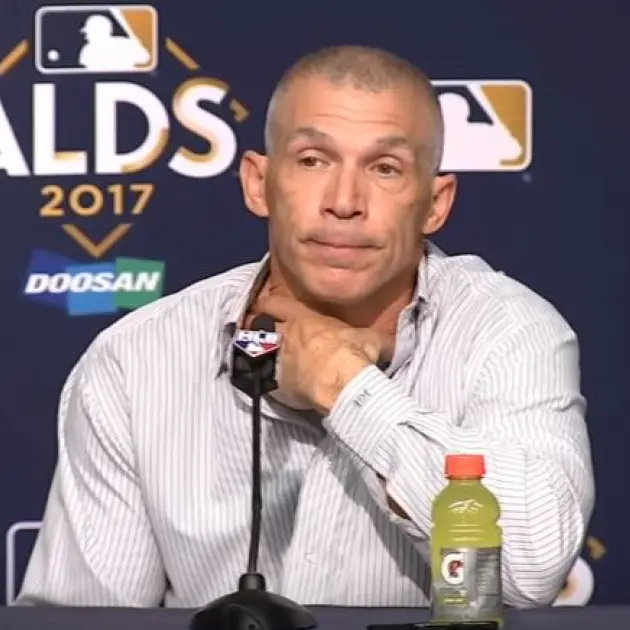
The removal of the Yankees against the Tampa Bay Rays continues to raise strong questions around the organization, but Joe Girardi believes that one of the most important problems can be found within the clubhouse itself.
The former leader of New York questioned how the team executed basic fundamentals during the postseason and, mainly, the response of some players after making mistakes that ended up costing important opportunities.
Girardi did not directly hold Aaron Boone responsible for the elimination.
His concern is related to something deeper: discipline, execution and responsibility.
Girardi questions the fundamentals of the Yankees
During an appearance on The Show with Joel Sherman and Jon Heyman, Girardi used several plays from the divisional series to explain his concern.
One of the examples was Austin Wells' mistake running the bases during Game 1 against Tampa Bay.
Wells tried to advance to third base after connecting a double and ended up being eliminated, wasting one of the few offensive opportunities New York had during a match dominated by Drew Rasmussen.
Girardi also pointed to the costly defensive error of Jazz Chisholm Jr. during Game 2.
On that play, Jazz tried to complete an aggressive action and ended up making a bad shot inside a inning in which the Yankees defense fell apart.
To rotate, the problem is not just in making the mistake.
Mistakes are part of baseball.
The worrying thing is how you respond after committing them.
Jazz Chisholm's reaction especially caught his attention
Girardi particularly questioned that Chisholm would say after the game that he would probably try to make the same move again.
For the ex-manager, that kind of answer represents exactly the problem that needs to be corrected.
When a decision does not work and ends up harming the team, there must be the ability to recognize it, learn and make the corresponding adjustment.
Automatically repeating the same action cannot become the answer.
That was one of the central points raised by Girardi.
Responsibility does not simply mean publicly accepting that an error occurred.
It means understanding why it happened and preventing it from happening again.
“enough” with certain errors
Girardi considers that some situations must be corrected long before reaching October.
errors running the bases.
poor landslides.
unnecessary defensive decisions.
Execution failures in routine situations.
For the former leader, when those problems appear repeatedly during the regular season, someone within the organization has to intervene.
It cannot be waited until the postseason to try to correct fundamentals that had to be worked on for months.
And when the same situation begins to repeat itself, Girardi understands that there has to be a time when the internal message is clear: it is enough.
Anthony Volpe was used as a positive example
Girardi also mentioned Anthony Volpe to explain how a strong decision may end up benefiting a player.
Volpe lost his starting shortstop during the season and was sent to Triple-A after going through a difficult period.
According to Girardi's analysis, the player showed a better version when he returned to the Major Leagues.
The reason is simple.
The demotion forced Volpe to acknowledge that what he was doing was not working.
He had to make adjustments.
He had to answer.
And to Girardi, that kind of consequences may be necessary when a player continues to repeat mistakes.
The former manager does not blame Aaron Boone
Despite his criticism of the team's performance, Girardi came out in defense of Aaron Boone.
The elimination again provoked orders for the Yankees to change their leader, especially after another season that ended without a championship.
Girardi, however, considers it unfair to place all responsibility on Boone.
He even stated that 2026 could have been one of Boone's best seasons as manager.
The Yankees had to overcome multiple injuries and seasons below the expectations of some important players.
Even so, they ended with one of the best records in the American League.
Boone also had to change the way the team won games.
Instead of relying solely on a powerful offensive, New York ended up leaning much more on its pitching.
Girardi particularly highlighted Boone's handling of the bullpen.
Is the problem in the players?
Girardi's posture puts an important discussion on the table again.
How far does the manager's responsibility go and where does the player's responsibility begin?
The leader can prepare.
can explain.
You can establish a strategy.
You can decide who plays.
But when the game begins, it is the players who have to execute.
A manager cannot complete a double play.
You can't decide for a runner when to stop at second base.
You can't catch a ball.
You cannot make a precise shot towards the first.
That is why Girardi understands that several of the problems that affected New York during October cannot be attributed exclusively to Boone.
The clubhouse culture now enters into discussion
The most significant thing about Girardi's statements is that they take the conversation beyond a particular decision.
You are asking if there is enough responsibility inside the clubhouse when a player makes a mistake.
Does anyone correct it?
Are there consequences?
Is the problem identified and working immediately?
Or does the page just turn around until it happens again?
These questions become more important after a postseason where different fundamental errors ended up appearing at critical moments.
The defense was especially expensive against Tampa Bay
The Yankees did not lose the series for a single play.
But the defense played an important role at various times.
Game 2 was the most obvious example.
New York made four mistakes during the defeat.
Three came only in the first inning.
Against a team like Tampa Bay, which is constantly trying to exert pressure, giving away additional outs represents a huge disadvantage.
The Rays took advantage of those opportunities.
And the Yankees could never fully recover.
Not everything can be explained by analytics or manager decisions
Over the past few years, much of the criticism around the Yankees has been related to analytics, roster construction, and Aaron Boone decisions.
All that is part of the conversation.
But Girardi introduces another element that cannot be ignored.
the fundamentals.
Modern baseball can use all the information available, but a team still needs to execute the basic plays correctly.
Run the foundations well.
Know when to shoot.
complete the routine play.
Make smart decisions under pressure.
In October, such an error may end up changing an entire series.
The Yankists: Here's a review that Yankees needs to hear
from the perspective of The Yankists, the words of Joe Girardi deserve a lot of attention.
Because this conversation cannot be reduced to deciding if Aaron Boone continues or if Brian Cashman makes any changes.
The players also have responsibility.
When a runner makes a mistake at the bases, he has to learn.
When a player makes a bad defensive decision, he has to recognize it.
And when the same problems are repeated, someone within the organization has to intervene.
That doesn't mean creating a fear-based clubhouse.
It means setting standards.
The Yankees want to win a World Series.
So they have to run as a team that aspires to win a World Series.
Winter will have to include something more than name changes
New York will have many opportunities to modify the roster before 2027.
There will be free agents.
possible exchanges.
decisions about important players.
and debates about Aaron Boone and Brian Cashman.
But hiring different players won't automatically fix all the problems if the same fundamental errors continue to appear.
The organization will also have to evaluate how it prepares its players, how to correct errors, and what level of responsibility exists internally.
Girardi knows perfectly well the pressure of directing the Yankees.
He was the last manager who managed to take a championship to the Bronx.
And your message after another delete can be summarized in a very simple way:
The Yankees have enough talent to compete.
Now they need to make sure you play with the discipline and responsibility necessary to win when it really matters.