
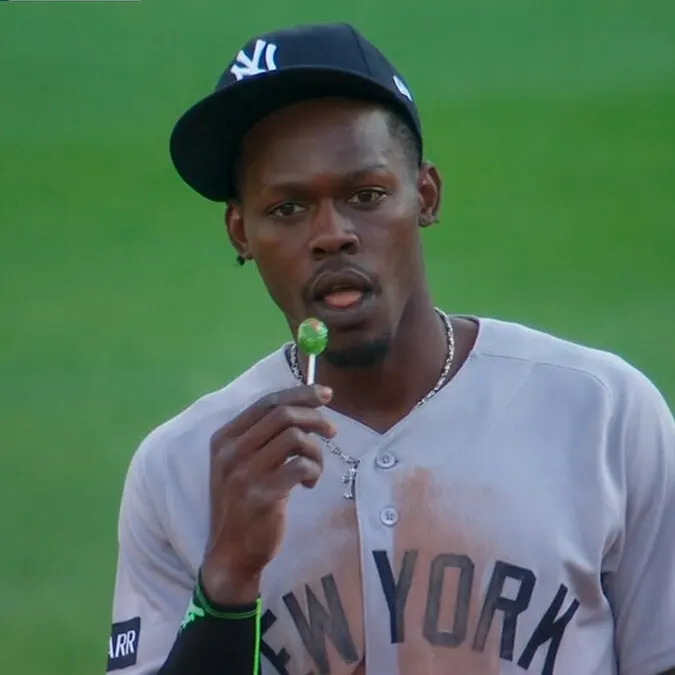
The future of Jazz Chisholm Jr. with the Yankees has become one of the most interesting decisions that the organization will have to make this winter.
After two and a half seasons in New York, the second baseman is on his way to becoming a free agent and, although he has publicly expressed his desire to continue wearing the striped uniform, there are more and more questions about whether the Yankees will really try to hold him to 2027.
An analysis published by the New York Post raises even the possibility that the Chisholm stage in the Bronx has come to an end.
That doesn't mean that there is an official decision yet.
But the combination of its performance during 2026, the price it could squeeze in the market, and the internal alternatives that the Yankees manage make its future a much less clear situation than it seemed a year ago.
Jazz Chisholm Jr. will hit the market after an irregular season
Chisholm started 2026 with huge expectations after becoming a 30-30 player during the previous season.
He even spoke publicly during training on much more ambitious targets.
However, his offensive production ended up falling considerably.
Jazz played 137 games during the regular season and finished with an average of .231, on-base percentage of .312 and .399 slugging.
He hit 19 home runs, drove 55 runs and scored 69.
His speed was once again one of his main weapons.
He stole 41 bases, a figure that kept him among the most dangerous runners in the American League.
But his .711 Ops and a 97 OPS+ reflect that, in general terms, his offensive production ended slightly below the league average.
He also struck out 157 times in 471 official shifts.
For a player who will enter the free agency, probably looking for an important multi-year contract, those numbers greatly complicate the evaluation.
Jazz talent has never been the big question
When analyzing Chisholm, it is difficult to question his tools.
has power.
has speed.
You can change a match with your legs.
He can make spectacular defensive plays.
And when he goes through one of his best offensive moments, he brings an energy that few players inside the roster can replicate.
The problem has been to turn all those tools into consistent production.
During his time in New York there were brilliant moments, but also mistakes running the foundations, questionable defensive decisions and prolonged periods in which his offensive disappeared.
It is precisely this irregularity that can now influence the decision of the management.
The defense presents a complicated evaluation
The jazz defensive season also left contradictory signals.
Advanced metrics do not fully match your performance.
Chisholm finished with 15 Above Average, a figure that placed him among the best major league players in that metric.
However, Defensive Runs Saved evaluated it much less favorably.
This difference reflects part of the difficulty that exists in evaluating its defense.
Jazz has enough athletic ability to make plays that many other players simply cannot complete.
But you can also make execution mistakes or make too aggressive decisions.
That contrast was exposed again during the postseason.
After a costly defensive play against Tampa Bay, his public response also sparked criticism and fed back the conversation around the fundamentals and the responsibility within the team.
Qualified offer will be an important decision for Yankees
Before you get fully to free agency, the Yankees will have to determine if they present a qualified offer to Chisholm.
The projected value for that offer is around 23.25 million dollars for one season.
Under normal circumstances, a 29-year-old with power, speed, and ability to play second baseman could be an obvious candidate to receive her.
If Jazz refused the offer and signed with another team, New York could receive a compensatory selection in the draft.
The problem is the risk that you accept it.
After an offensive season below your expectations, there is no guarantee that Chisholm will immediately find the multi-year contract he could be looking for on the market.
The New York Post posits precisely that this risk could lead the Yankees not to make the offer.
That would be an important sign of how the organization evaluates its continuity internally.
Anthony Volpe can completely modify the situation
The decision with jazz cannot be analyzed in isolation.
The Yankees have different pieces that can modify the structure of the inner frame in 2027.
Anthony Volpe began receiving opportunities at second base after losing regular startup on shortstop.
Its offensive future continues to raise questions, but economically represents a much less expensive alternative.
That matters for an organization that will have to distribute resources in different areas of the roster this winter.
If the Yankees believe that Volpe can become a reliable second base, the need to invest a significant amount of money in jazz decreases considerably.
The team could then use those resources in other positions.
Luis García Jr. represents another internal alternative
Luis García Jr. can also be part of the equation.
Although the Yankees mainly used it in first base after acquiring it, Garcia has extensive experience playing second.
Aaron Boone has already talked about his defensive flexibility and there is a possibility that during the winter he will return to work specifically in that position.
García played more than 500 games as second baseman during his first seasons with Washington.
If he manages to show that he can still defend the position in an acceptable way, New York could use it there during certain clashes.
That would also allow opening more turns at first base for Ben Rice.
In this way, a possible jazz outing would not necessarily force the Yankees to immediately spend a large amount of money looking for another second base on the market.
The second base market also offers other alternatives
Jazz will not be the only player in the available position.
The free agent class includes names like Brandon Lowe, Luis Arraez and Gleyber Torres, as well as other players who could be available through contractual options or exchanges.
But each alternative has its own questions.
Some will require major multi-year contracts.
Others have defensive limitations.
And returning to a player like Gleyber Torres could return the team precisely to some of the execution problems and fundamentals that he has tried to correct in recent years.
That is why using an internal solution may end up being the preferred option.
Jazz has said that he wants to remain Yankee
You also have to consider the other side of this story.
Chisholm hasn't said he wants to leave.
Quite the opposite.
After the elimination against Tampa Bay, he made it clear that he would like to continue in New York.
He enjoys playing for the Yankees and feels comfortable inside the clubhouse.
That is why any separation would not necessarily occur because the player wants to find another destination.
The decision may end up being mainly sporty and financial by the organization.
MLB already places Jazz among the main names of the second base market for this winter, so there will surely be teams interested in exploring its combination of power and speed.
The Yankees have to decide what they learned from the experience
The jazz situation represents something bigger than simply determining if a player deserves another contract.
The Yankees are evaluating what kind of team they want to build.
After another elimination in October, Joe Girardi publicly questioned the foundations and responsibility within the clubhouse.
Aaron Judge asked management to identify weaknesses and make the necessary changes.
And now Brian Cashman will have to determine which players really fit into the next version of the team.
Jazz offers extraordinary tools.
But New York will have to decide how much you also value consistency, execution, and attention to small details.
The Yankists: letting go of Jazz is not a simple decision either.
from the perspective of The Yankists, there is a risk on both paths.
Holding Jazz through an expensive contract after an irregular season can limit the resources available to improve other areas.
But letting it go also means losing a 29-year-old capable of connecting 20 or more home runs and stealing 40 bases.
There are not many players with that combination.
That is why the decision should not be made solely based on the mistakes he made during the postseason.
The Yankees need to evaluate the entire package.
your offensive.
your defense.
your speed.
your price.
And, mainly, what real alternatives they have to replace it.
If Volpe can be established at second base or Luis García Jr. can regain his position, allowing Jazz to reach the market makes much more sense.
If those options don't work, New York might end up discovering that replacing your tools is more difficult than expected.
Everything points to a decisive winter for Jazz Chisholm Jr.
For now there is no official announcement that closes the jazz stage in New York.
That is important to make it clear.
But the signs around the organization indicate that its continuity is far from guaranteed.
The Yankees must decide whether to make the qualified offer.
Then they will have to determine how much money they would be willing to commit to a new contract.
And at the same time they will evaluate Volpe, García and any alternative available on the market.
Jazz came to New York as an acquisition capable of bringing energy, power and speed.
Two and a half seasons later, his future is open again.
His next big career decision can determine if he continues to be part of the Yankees' attempt to return to the World Series or if 2026 ended up being his last season dressed in striped.