
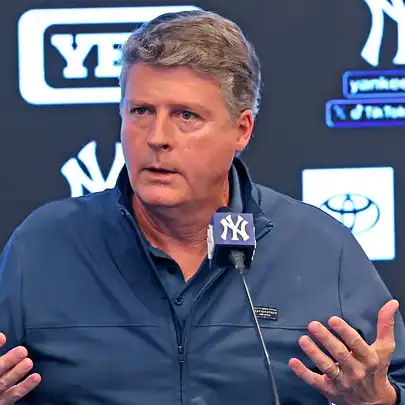
The Yankees have already started to define what went wrong in 2026 and what should be one of their top priorities during the offseason.
For Hal Steinbrenner, the diagnosis starts directly with the offensive.
The Yankees owner acknowledged that the lack of consistent production ended up significantly hurting the team during a season that ended with another early elimination in October.
New York won 93 games, eliminated Boston in the wildcard series, and featured one of the best major league pitchers.
But when the divisional series against Tampa Bay arrived, the Bates practically disappeared.
That contrast seems to have clearly marked Steinbrenner's assessment of what needs to change course to 2027.
The Yankees offensive regressed considerably in 2026
The numbers show why Steinbrenner is worried.
The Yankees scored 849 runs during the 2025 season.
In 2026 that figure fell to 739.
There are 110 races less from one year to the next.
The collective average also decreased.
New York went from batting .251 in 2025 to only .235 during 2026.
The on-base percentage fell from .332 to .311.
and the home runs decreased from 274 to 223.
The Yankees still retained an important ability to hit home runs, but they had too much difficulty in generating constant traffic at the bases.
That ended up making the offensive depended too much on power and certain players.
The problem was fully exposed against Tampa Bay
The wildcard series had created a very different image.
The Yankees eliminated Boston in two games after scoring 18 runs and hitting 26 hits.
It seemed that the offensive had found its best version precisely when October began.
But against Tampa Bay the opposite happened.
New York scored only five runs during the three divisional series matches.
The team hit 12 hits.
Batt just .130.
And he ended up with only two home runs throughout the series.
The Rays only needed three games to end the Yankees season.
Meanwhile, New York pitching posted a 2.52 collective ERA during the series.
For Steinbrenner, that difference is hard to ignore.
Steinbrenner does not place the primary responsibility on Boone
The owner's statements also help to understand why Aaron Boone will continue as manager in 2027.
Steinbrenner does not consider that the end of the season can be placed mainly on the shoulders of the leader.
His evaluation points much more to position players and their inability to consistently produce races.
Boone can set the lineup.
You can decide when to use a pop-up batter.
can handle the bullpen.
You can design strategies together with the coaching staff.
But once the game starts, the batters have to run.
And for the owner, that didn't happen often enough during 2026.
Cashman also retains Steinbrenner's confidence
Brian Cashman will also continue to lead the baseball operations after reaching an agreement for a new contract.
That means the Yankees have decided to maintain the main leadership structure.
Cashman will continue to build the roster.
Boone will continue to manage it from the dugout.
That is why it is even more important to observe where the changes will occur.
Everything indicates that a good part of them will have to arrive directly in the composition of the roster.
Judge and Stanton's injuries hit the offensive hard
The offensive production of 2026 cannot be analyzed without considering the injuries.
Aaron Judge and Giancarlo Stanton were out for major periods of the season.
More than 80 games were lost between the two.
Judge, in addition, could not participate in the postseason.
Losing a batter of his level completely modifies the construction of the lineup.
Rival pitchers may attack differently from the rest of the batters.
One of the main sources of power disappears.
And it also decreases the ability of the team to receive bases by balls and generate traffic.
But injuries can't become the only explanation either.
An organization with championship aspirations needs enough depth to survive when a star is not available.
Yankees had power, but too little contact
One of the most important contradictions of the offensive was that New York continued to connect many home runs.
The Yankees finished among the best teams in the Major Leagues in home runs.
The problem was in everything that happened between those hits.
The team ended up near the MLB bottom in batting average.
He was also among the worst in on-base percentage and total number of hits.
That means too many innings started without runners.
Too many threats depended on a single swing.
And when the home run did not appear, the offensive had difficulty producing in other ways.
The market can force Yankees to look for another type of batter
That problem can directly influence Brian Cashman's decisions during the winter.
Yankees do not necessarily need to add another batter whose main attribute is to connect 30 home runs.
They need players to complement what already exists.
Batters capable of placing the ball in play.
players who reach base.
more speed.
best shifts with two strikes.
and greater capacity to produce against quality pitching.
Especially during October, when offensive opportunities decrease considerably.
The possible exit of Jazz Chisholm Jr. raises questions
The jazz situation Chisholm Jr. will be one of the decisions that can modify the 2027 offensive.
Jazz can become a free agent and has expressed his desire to continue in New York.
But the Yankees will have to decide how much they are willing to invest to hold him.
If he doesn't return, New York would lose speed, power, and a player capable of creating base pressure.
An important position would also remain open within the inner box.
Anthony Volpe could appear as a second base alternative, but that possibility would not eliminate the need to add offensive production to another part of the roster.
The third base continues to need answers
The third baseman also appears among the positions where New York can try to improve the offensive.
Ryan McMahon brings defense, but the Yankees need to assess whether they get enough full production from that position.
That is why different options can come into consideration during the winter.
Even the international market can offer alternatives.
Teruaki Sato, winner of the Triple Crown in Japan, is one of the names that could be interesting if it is finally available to the Major League teams.
But any addition will have to answer a fundamental question.
Does it really make the offensive better and more complete?
Young people also have to be part of the solution
Not everything can be resolved through free agency.
The Yankees already have more than $200 million committed to a small group of players by 2027.
That is why internal development will be fundamental.
Ben Rice.
George Lombard Jr.
Spencer Jones.
Those players can allow New York to get production without paying free agent price in all positions.
Rice can become an important piece of the middle part of the lineup.
Lombard brings speed, defense and pressure to put pressure.
Jones possesses enormous power, although he needs to considerably reduce strikeouts.
The growth of that group can determine how much money you need to spend cashman during the winter.
Aaron Judge needs a less dependent offensive on him
This is probably one of the most important points to build the 2027 team.
The Yankees cannot redesign an offensive where everything changes completely when Aaron Judge is not available.
Judge will continue to be the main hitter.
That is not under discussion.
But a team that aspires to play until the end of October needs different sources of production.
Especially since the captain will reach a stage of his career where keeping him healthy will be more and more important.
The Yankees will have to find a way to give them more days as a designated hitter without completely blocking that position.
Giancarlo Stanton's health is also part of that equation.
The bullpen will be another priority, but the offense can lead the list
New York will also need to work in the bullpen.
David Bednar has a contractual situation to resolve.
Paul Blackburn can reach the market.
Other relievers could also leave.
That forces Cashman to rebuild part of the latest entries.
However, Steinbrenner's statements make it clear that the offensive takes a central place in the season's evaluation.
And it makes sense.
The pitching corps kept New York within many matches.
The problem was that too many times he received little support.
Steinbrenner wants answers, not just changes to change
The offseason can bring important moves.
But the Yankees should also not act simply to publicly show that they are doing something.
Each addition has to solve a specific need.
more contact.
more on-base.
Defense.
speed.
depth.
and players capable of responding against the best pitching.
The elimination against Tampa made it clear that having many recognized names does not guarantee a functional offensive in October.
The Yankees: the problem is not fixed by adding only more power
from the perspective of The Yankists, Steinbrenner is right to place the offensive among the top priorities for 2027.
But the solution shouldn't just consist of looking for more home runs.
The Yankees already have power.
What they need is a more complete offensive.
A lineup capable of making a run when the home run does not appear.
A team that can place runners on the move.
that can produce a single with a man in second.
that can extend an inning with two outs.
that forces the rival pitcher to work.
and that it is not completely neutralized when it faces a dominant opener.
That is what October demands.
2027 will test Steinbrenner's diagnosis
The Yankees have already begun to make important decisions.
Brian Cashman will follow.
Aaron Boone will follow.
Rotation continues to be a strength.
There are young people prepared to receive more opportunities.
Now the attention is heading towards an offensive that regressed considerably during 2026 and that fell short again when the divisional series arrived.
Hal Steinbrenner has identified the problem.
The next step will be to check how aggressively you are willing to fix it.
Because after 17 consecutive seasons without winning the World Series, identifying weaknesses is no longer enough.
The Yankees have to correct them.