
The Yankees have spent much of the last few years looking for a new generation of players capable of complementing their great stars and reducing dependency on free agency.
While names like George Lombard Jr., Spencer Jones, Ben Rice and Cam Schlittler have already started to get into the big league conversation, another young man is rapidly moving behind them.
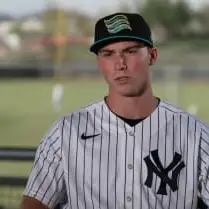
His name is Dax Kilby.
He is only 19 years old.
He is currently the number one prospect for the Yankees according to MLB Pipeline.
And what he is doing in the Arizona Fall League begins to explain why New York considers that he has one of the most interesting position players in his entire system in his hands.
Kilby is producing against much older players
The first characteristic that makes his performance in Arizona special is precisely age.
Kilby is competing against players who, on average, are almost three years older.
Many have considerably more experience in professional baseball.
Some have already gone through higher levels of the minor leagues.
That has not prevented the young Yankees shortstop from being one of the most productive hitters in Salt River.
In his first 15 games of the Arizona Fall League, he registered an offensive line of .295/.357/.623.
Twelve of his first 18 hits were extra-base.
That means two out of three hits produced at least two bases.
For a 19-year-old facing considerably more advanced talent, those numbers immediately draw attention.
It's not just about the average
One of the most interesting things about Kilby's development is that its stats show different tools working at the same time.
He's not just a young hitter taking advantage of a good streak.
He is hitting the ball with authority.
His percentage of strong hits in Arizona reached 45.3%.
In addition, it recorded a maximum output speed of 109.8 miles per hour.
Those numbers help support what you see when you make contact.
There is real force in your bat.
And we are still talking about a player whose body can continue to develop for years to come.
Speed adds another dimension
Kilby also doesn't need to rely solely on his bat.
Speed is an important part of your profile.
During the Arizona Fall League, he recorded three races classified as “Bolts”, which correspond to sprint speeds of at least 30 feet per second.
It was one of the highest figures within Salt River.
That athletics opens different possibilities.
can take an additional basis.
You can convert some singles to doubles.
can put pressure on the defense.
And it can add value even in matches where the bat does not produce extra-base.
For an organization that during different stages has needed greater speed and athletics, that aspect of Kilby is especially interesting.
What impresses those around him most does not appear in the statistics
However, there is another aspect that his colleagues and instructors have constantly pointed out.
his maturity.
Kyle West, Kilby's partner both within the Yankees system and at Salt River, has highlighted how difficult it is to believe that he is still only 19 years old when he observes his way of working and behaving.
J.T. Etheridge has also highlighted the consistency, tools, and professional way Kilby faces the game.
That kind of comments has value.
Many prospects have physical talent.
The challenge is to develop a routine capable of allowing that talent to survive when competition increases.
And those who are working daily with Kilby consider that it already shows a much more advanced mentality than its age.
Yankees made a major bet in the 2025 draft
Kilby came to the organization through the 39th draft of the 2025 Draft.
The Yankees chose him directly from high school in Georgia.
He later signed for approximately US$2.8 million.
From that moment it became clear that the organization did not simply see him as another young player within the system.
New York was making a significant investment in its offensive capacity.
So far, Kilby has begun to justify that trust.
His 2026 season was marked by injuries
The development, however, has not been completely simple.
Kilby had problems with the hamstring during the season.
A first injury kept him out for about two months.
He briefly returned at the end of May.
After only two shifts he was left out again for several weeks.
That significantly limited their first full year within the system.
He ended up participating in just 36 games between the Florida Complex League and Class A.
For such a young player, losing so many turns can greatly delay development.
That is why the Arizona Fall League acquired even greater importance.
Arizona is giving him the turns he lost
Kilby's participation in Arizona was not designed solely to produce numbers.
The main objective was to recover competitive time.
I needed to face pitchers.
I needed to accumulate turns.
I needed to repeat routines.
And I needed to experience the process of making adjustments against higher-level players.
So far, it's doing much more than just making up for lost time.
He is showing that he can compete.
His discipline on the plate was an important sign during 2026
Even before reaching Arizona, there were numbers that showed an unusual offensive profile for such a young player.
During his participation in the minors, Kilby registered a base rate per ball of 24.4%.
It was the highest among the Yankees minor league players who accumulated at least 160 plate appearances.
At the same time, their failed swing rate was only 9%.
The combination is important.
Not only shows patience.
It also indicates ability to recognize launches and control the area.
Many young hitters have impressive tools, but they need years to learn which pitches should attack.
Kilby is already showing signs of having an advanced base on that aspect.
Yankees even decided to modify a swing that was already working
One of the most striking elements of his participation in Arizona is that the team did not simply decide to leave him alone after a good first professional stage.
The Yankees began to make major changes to their offensive mechanics.
Kilby changed her starting position on the plate.
It went from a broader and more closed posture to starting narrower and more open.
The intention is to optimize your movement and allow you to use your tools even more efficiently.
That represents a risk.
Changing the mechanics of a player who is already producing always requires trust between prospect and instructors.
But the first results indicate that Kilby has been able to make adjustments without losing production.
Power begins to appear more clearly
When selected, one of the main questions was related to how much power he would end up developing.
Kilby had shown ability to hit.
I had speed.
controlled the area.
But it still remained to determine how much damage it could generate consistently.
What happened in Arizona offers an interesting first answer.
A slugging of .623.
Twelve extrabases among its first 18 hits.
exit speeds close to 110 miles per hour.
That doesn't mean that it will automatically become a 30-home hitter.
But it does show that there is more impact on contact than perhaps some initially projected.
Shortstop is still your position for now
Kilby has received her recent defensive opportunities mainly as a shortstop.
The Yankees still have a long time before they need to definitely define where they will play in the big leagues.
Its athletics allows you to keep different options open.
You can continue to develop in the shortstop.
It could also eventually move to another position in the frame depending on how it develops physically and the needs of the organization.
At this point, rushing that conversation doesn't make much sense.
You must keep batting first.
keep developing.
and show that you can handle each new level.
Yankees start building young depth in the inner box
The presence of Kilby also acquires greater interest when the rest of the system is observed.
George Lombard Jr. has already reached the Major Leagues.
Core Jackson continues to develop.
Anthony Volpe is still part of the inner box conversation.
And Kilby now appears as one of the highest-rated talents within the entire organization.
Having different alternatives is exactly what a minor league system needs.
Not all prospects will arrive.
Not everyone will occupy the position where they were originally developed.
But the greater the number of players with real tools, the more flexibility Brian Cashman will have to build future rosters.
His age turns all this into something even more interesting
Perhaps the most important aspect of Kilby is that she still has time.
long time.
You don't need to be at Yankee Stadium in a few months.
There should be no need to artificially accelerate its development.
At 19 years old, simply compete successfully in the Arizona Fall League already represents a positive signal.
Doing so while modifying your swing and recovering turns after several injuries further increases the value of what you are getting.
The Yankees can allow each stage to occur when appropriate.
Comments within the clubhouse also matter
External evaluations are often concentrated exclusively