
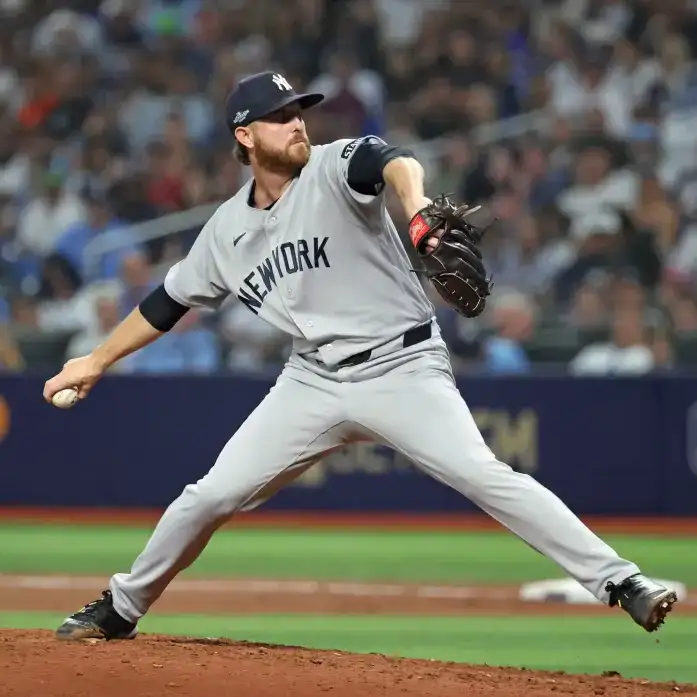
One of the groups that generated the most questions around the Yankees before starting the postseason is offering a very different answer than expected.
The New York bullpen, marked during different times of the season as a possible weakness for October, has so far been one of the team's most effective units.
Throughout the first three games of these playoffs — the two wins against Boston in the Wild Card series and the 1-0 loss to Tampa Bay at the start of the ALDS — the Yankees relievers have only allowed one race, two hits and three Bases on balls in 8 innings and two thirds.
It is a small sample, but it arrives precisely when the margin of error is reduced and each out acquires a much higher value.
The Yankees Bullpen is responding when it matters most
The concern around the relay did not appear out of nowhere.
During the season, the Yankees had to handle injuries, role changes, wear and tear and several alternatives that did not end up offering the expected stability.
The organization also did not make a major addition to reinforce the bullpen before the exchange deadline, a decision that raised doubts about how Aaron Boone could handle the final tickets in October.
So far, the answer has come from within.
The relievers have done their work and have allowed Boone to manage the games without the bullpen becoming the problem that many anticipated.
David Bednar continues to be a fundamental piece
David Bednar continues to occupy one of the most important positions within the structure of the bullpen.
The right-hander came to the postseason as one of the most trusted alternatives for the final innings and has maintained that stability.
Its ability to attack the area, get strikeouts and handle pressure situations offers Boone a clear option when the Yankees arrive with an advantage to the last innings.
In short series, having a reliever capable of closing games can completely modify the way a leader uses the rest of his pitchers.
Boone doesn't need to wait until the ninth episode to think about Bednar. Depending on the heart of the rival lineup, you can use your best arm at the time of greatest danger.
Paul Blackburn has become a very valuable option
Paul Blackburn is also offering important innings.
Its value increases because it can work more than one input and function as a bridge between the opener and the closing arms.
In Game 1 against Tampa Bay, he pitched a two-thirds inning with no runs, helping to keep the score 1-0 after Gerrit Cole's departure.
That kind of presentation may not get as much attention as a save, but it can be just as important during a divisional series.
If a starter leaves after five innings, Boone needs to find nine, ten, or even twelve additional outs.
Blackburn offers the possibility of covering several of them without using four different relievers.
Ryan Weathers can become an unexpected piece
One of the most encouraging news of the first match against Tampa Bay was the return of Ryan Weathers.
The left-hander had been out of action for several weeks due to an injury to the left forearm flexor and returned to ALDS in a different role than he played for much of the season.
It is now available from the bullpen.
His first appearance was exactly what the Yankees needed.
Weathers worked a clean inning using only nine pitches and got three rolls to first base.
He did not need to look for strikeouts or perform a high number of pitching.
He attacked the area, generated weak contact and quickly finished his work.
Aaron Boone was satisfied with what he saw and believes that Weathers can become a major piece during the postseason.
Weathers versatility changes Boone options
Weathers can offer something especially useful in October: length.
Unlike a reliever used exclusively for three outs, the left-hander has experience as a starter and can work several tickets if the match requires it.
That can be fundamental in a best-of-five series.
If a starter has a short output, Weathers can help prevent Boone from completely burning the bullpen.
It can also be used in a specific confrontation against left-handed hitters or even as a bridge to Bednar and the most trusted arms.
That flexibility takes on even more value because the Yankees have several quality starters and can turn some of those arms into additional options during October.
Brent Headrick is still a situation to observe
Not everything inside the bullpen is completely defined.
Brent Headrick was one of the Yankees' most used relievers during the regular season, but his speed has shown a recent decline.
In his appearance against Tampa Bay, his straight average averaged 92.6 miles per hour, below the 94.1 he had averaged during the season.
That doesn't automatically mean you can't help.
In fact, he managed to get out of a complicated situation in Game 1.
But it does represent something that Aaron Boone will have to watch carefully.
In October, roles can change quickly depending on performance, rest and clashes.
Injuries forced Yankees to seek solutions
Part of the doubts surrounding the bullpen were related to the arms that were no longer available.
Clarke Schmidt returned to the injured list after a brief appearance.
Fernando Cruz finished on the 60-day injured list.
Other pitchers who received opportunities during the year did not end up consolidating themselves into important roles for the postseason.
That forced the Yankees to rebuild part of their plan on the go.
The current structure is not necessarily what the team imagined months ago, but so far it is working.
Will Warren also increases depth
Will Warren offers another interesting alternative.
After working mainly as a starter during the regular season, it can now be used from the bullpen.
Your experience starting matches means that you can provide multiple entries if the situation demands it.
Warren already contributed during the Wild Card series against Boston and represents another example of how the Yankees are using their depth of openers to strengthen the relay during October.
Instead of relying exclusively on traditional relievers, Boone has available pitchers accustomed to working multiple tickets.
Brian Cashman's bet begins to give results
The construction of the bullpen also returns under analysis one of the most questioned decisions of the season.
Brian Cashman decided not to make a major acquisition to reinforce the relief during the exchange deadline.
The organization relied on its internal options and the possibility of reorganizing the pitching staff when October arrived.
For several weeks that bet seemed risky.
Now, at least during the start of the postseason, the results are partially supporting that decision.
There is still a lot of baseball left.
Three parties cannot define the success of a strategy for an entire postseason.
But the Yankees needed this group to respond immediately and that is precisely what has happened.
Pitching did its job in Game 1 against Tampa Bay
The 1-0 defeat against the Rays is probably the best example.
Gerrit Cole allowed only one run in five innings.
Afterwards, the bullpen kept Tampa Bay without scoring for the rest of the match.
New York reached the ninth inning losing by the minimum because its pitchers kept the game within reach.
The problem was not in the bullpen.
He was on an offense that ended with a single hit and did not produce any races.
Aaron Boone was clear after the match: pitching did his job.
Concern is now moving on the offensive
It is a very different situation than the one that many imagined before starting October.
The bullpen was considered one of the great questions.
Now, after three matches, the main debate is around the batters.
The Yankees scored 18 runs during the two games against Boston, but Drew Rasmussen completely limited them in ALDS Game 1.
The relay can keep the marker closed.
Openers can offer great presentations.
But New York will need to produce races if it intends to eliminate Tampa Bay.
The Yankists: The bullpen is changing the conversation
from the perspective of The Yankists, the performance of the bullpen is one of the most positive news that has left the beginning of the postseason.
It does not mean that all doubts have disappeared.
Nor does it mean that Boone has all roles defined.
But it does mean that a group that came to October under observation is offering important outs when the team needs them most.
Bednar offers stability for the final inputs.
Blackburn can provide length.
Weathers adds a left-handed arm capable of working several episodes.
Warren represents another option of multiple innings.
Headrick is still available, although his speed should be kept under observation.
That gives Boone different paths to manage each match.
The real exam is just beginning
The bullpen has responded during the first three games, but the postseason changes rapidly.
A complicated entry can modify the roles.
An extrainnings match may force you to use arms that were not originally in the plan.
A short output from a opener can test all the depth available.
That is why it is still too early to declare the problem solved.
However, the Yankees can get to Game 2 against Tampa Bay with an important certainty:
Until now, the bullpen has not been the weakness that many feared.
And if the relievers continue to launch in this way, the pressure will move directly into an offensive that now needs to take advantage of the excellent work of its launcher body.